
Think about a time when someone made you feel valued.
It may not have been a big gesture. Maybe they listened without interrupting, remembered your name, encouraged you after a difficult day, or gave you another chance when things did not go as planned.
Moments like these stay with us because they remind us of something everyone deserves: dignity.

Human dignity is the belief that every person has worth simply because they're human. It's not something that must be earned through good behavior, high grades, participation, or achievement.
In schools, practicing human dignity matters because students are learning more than academic skills.
They're also learning how to see themselves and their place in the world. Every interaction can either strengthen a student's sense of worth or weaken it.

But understanding human dignity is only the beginning. What truly matters is how it shows up in the moments teachers and students share each day.
Let's explore some ways that you can practice human dignity as a teacher.
See the Person Beyond the Student
Before teachers can support students, they first need to see them as more than learners.
 Photo by Sushanta Rokka on Unsplash
It can be easy to focus on the parts of students that are most visible in the classroom — how they perform, participate, behave, or engage in learning.
But what we see in the classroom is often only part of the story. Behind every student is a unique combination of experiences, strengths, challenges, responsibilities, and dreams that may not be immediately visible.
Think of it like an iceberg. As a teacher practicing human dignity, aim to find out what lies beneath the surface, and better understand who your students are beyond their "student" selves.
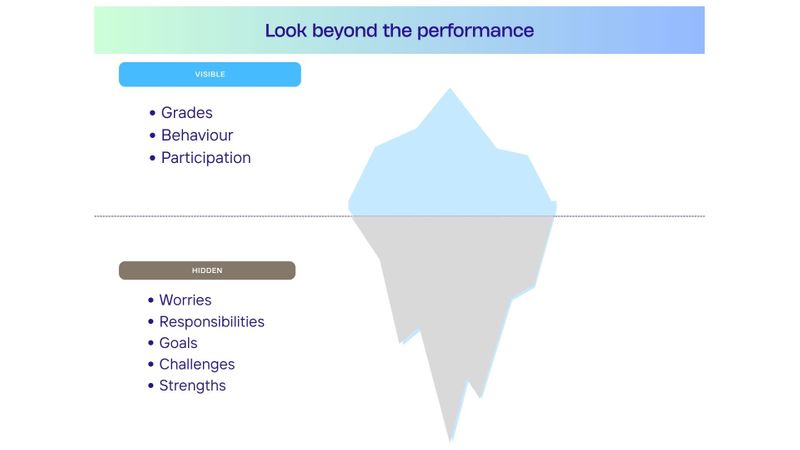 Image created by the author using Canva
Practice human dignity by:
Asking questions before making assumptions.
Learning about students' strengths and interests.
Getting curious about what may be influencing a student's behavior.
Taking time to understand students as individuals.
Imagine this...
You have a student who's usually very involved in classroom discussions but seems very quiet lately.
How can you respond and act with human dignity? Select all that apply:
A. Review their participation record to analyze if there is something to be concerned about.
B. Create opportunities for different types of student engagement.
C. Have a conversation to check in with the student and better understand if something is affecting them.
D. Notice and acknowledge other ways they're contributing.
Quiz
Select all that apply:
Protect Dignity When Mistakes Happen
Learning is not always a straight path. There will be times when students give a wrong answer, forget an assignment, make a poor choice, or struggle to meet expectations.
How teachers respond during these moments can leave a lasting impression.
Video courtesy of Andy Barbour via Pexels. To hear an audio description of the video, click play on the audio player below:
A student's worth should never depend on getting everything right. When challenges arise, teachers can aim to focus on helping students learn from the situation rather than making themfeel ashamed about it.
Human dignity means:
Correcting behavior without attacking character.
Taking time to understand what happened before jumping to conclusions.
Giving students opportunities to reflect, recover, and try again.
Speaking respectfully, even during difficult conversations.
Focusing on solutions and next steps instead of blame.
Reminding students that one difficult moment does not define who they are.
In practice, human dignity can look like:

Instead of saying:
You should know how to do this by now.
There's no excuse for this kind of behavior.
This better not happen again in my classroom.
What is this? This is not what you were asked to do.

Consider saying:
Learning takes time. Let's work through this together.
Help me understand what happened.
Let's talk about how we can handle this differently next time.
That's an interesting start. Tell me how you got there.
Quiz: Sami's Classroom Behaviour
During a class activity, Sami begins talking, making jokes, and distracting classmates.
Frustrated, the teacher stops teaching and addresses Sami in front of everyone.
As you watch the video, pay attention to the teacher's reaction and consider whether the situation could have been handled differently.
Video courtesy of Max Fischer via Pexels. To hear an audio description of the video, click play on the audio player below:
How could the teacher have addressed Sami's behavior while protecting his dignity? Select all that apply:
A. Speak with Sami privately about the behavior and explain why it needs to change.
B. Continue the lesson without addressing the behavior to avoid making Sami uncomfortable.
C. Give Sami an opportunity to refocus and participate appropriately moving forward.
D. Use Sami's behavior as an example so other students understand the classroom expectations.
Quiz
Select all that apply:
Affirm Every Student's Value
One of the most powerful ways teachers practice human dignity is through the messages they send to students every day. These messages aren't always spoken directly.
Students notice:
who gets encouraged
who gets recognized
who gets another chance
who gets support
who gets heard
These interactions can influence how students see themselves.
Teaching with dignity intentionally communicates:

You matter.

You're capable.

You have something valuable to contribute.
This doesn't mean praising everything students do. It means recognizing their value even when they're struggling.
In the classroom, human dignity might look like:
Recognizing effort and growth.
Highlighting students' strengths.
Encouraging students during challenges.
Giving every student opportunities to contribute.
Communicating belief in students' ability to learn and improve.
Quiz: What Should Sami's Teacher Do?
After speaking with Sami privately, the teacher notices that he still seems withdrawn and unusually quiet during the next lesson.
Rather than making assumptions, the teacher decides to better understand Sami’s experience.
 Photo courtesy of Max Fischer via Pexels
How could the teacher practice listening with human dignity? Select all that apply:
A. Ask Sami open-ended questions about how he experienced the situation before drawing conclusions.
B. Decide that Sami’s perspective isn't needed and focus only on enforcing classroom expectations moving forward.
C. Listen to Sami’s perspective and consider whether there may be information the teacher does not yet know.
D. Offer reassurance and encouragement without first inviting Sami to share his perspective.
Quiz
Select all that apply
Take Action
Practicing human dignity in the classroom boils down to being a responsive and reflective teacher.
Ask yourself: What are the shifts I could make in my practice to help my students feel more seen, valued, and understood?
Practice these acts of human dignity with your students:
Your feedback matters to us.
This Byte helped me better understand the topic.