
 Image created by the author using Canva
It’s movie night, and 3 films pop up on your screen. How do you decide? Do you pick the one with your favorite actor, go with your gut feeling, or pick one at random?
Some choices are low stakes. If the movie isn’t great, you can stop and switch.
Other decisions carry more weight, like choosing what subject to study or deciding which job to accept.
Often, when faced with decisions like these, the hardest part can be organizing your thoughts. This can be especially true when choosing between different options that come with their own mix of pros and cons.
That’s where a decision matrix can help! It lays out what’s important, compares the options side by side, and guides you toward a clearer choice.

What Is a Decision Matrix?
A decision matrix is a simple table that helps you compare different options against a set of factors. Those factors become your criteria, which are the standards you use to judge what's best.
Choosing Criteria
Some criteria tend to stay the same across situations — for example, in hiring, candidates are judged by the same standards.
Others can shift depending on what matters most to you, such as salary versus work–life balance when weighing job offers.
Once you’ve chosen your criteria, you score each option using a simple scale — usually 1 to 5 — where higher numbers mean a better fit.
Example: Comparing Two Projects
Imagine you’re choosing between two projects. After thinking through what matters most, you’ve decided your criteria are:
impact
time required
resources
A decision matrix helps you compare how well each project meets your chosen criteria.
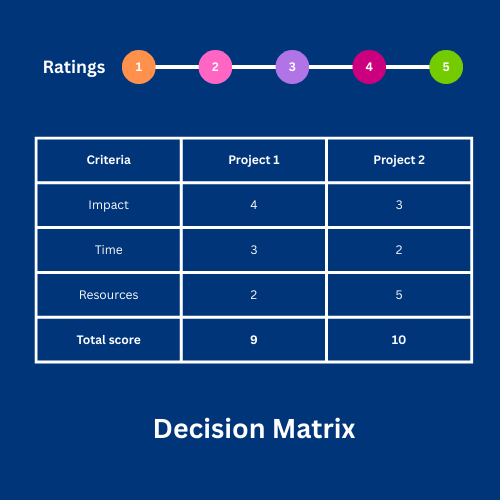 Image created by the author using Canva. To hear an audio version of the information in the image above, click the play button on the audio player below:
Making Sense of Your Options
A decision matrix can sometimes confirm your first instinct or make you pause and rethink. For example, you might prefer one project over another, but once you factor in the time it would take, you realize your schedule won’t allow it.
Scoring each option makes the pros and cons clearer, helping you choose the option that best supports your goals.

Quiz
What are some of the main benefits of scoring options in a decision matrix? Select all that apply:
Choosing Between Two Options
 Meet June, an assistant administrator.
She has a meeting with her line manager to discuss training opportunities that could help her grow in her role.
She wants to enroll in a course, but isn’t sure which one will help her the most.
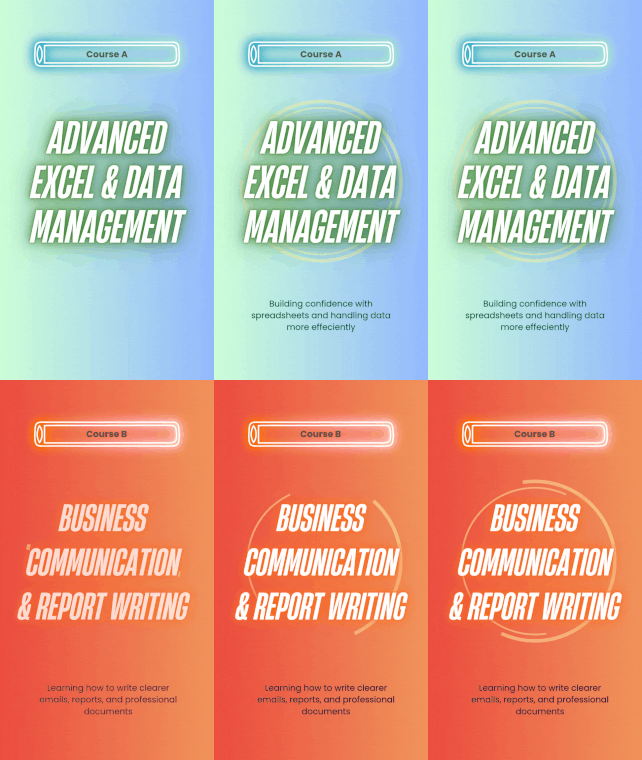 GIF created by the author using Canva
Creating Criteria
To help her decide, June thinks about what she hopes to get out of each course:
Skill development — What new skills will she actually gain?
Cost — Is it affordable or within the company’s budget?
Time commitment — Can she realistically fit it around her work?
Career relevance — Will it help her progress in her job at the company?
These questions help June figure out what’s most important in the short and long term, giving her the criteria to base her decision on.
 Scoring Guide
Using a scale from 1 to 5, she scores each course against the criteria:
5 = delivers strongly on this point
1–4 = delivers somewhat, with higher numbers showing a better fit
June's Decision Matrix
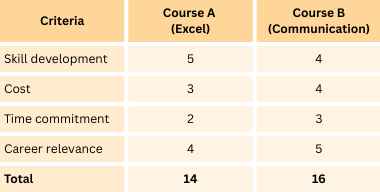 Image created by the author using Canva. To hear an audio version of the information in the image above, click the play button on the audio player below:
Looking at the results, Course B stands out as the stronger option for June’s current goals.
By structuring her choices this way, June reduces the sense of being overwhelmed and works through her options step by step. The decision matrix highlights the costs and benefits of each course, helping her feel more confident about choosing a course that best supports her career progression.
Quiz: Other Factors To Consider

What other factors could June include in her decision matrix to help her decide which course to take?
A. Enjoyment: If she doesn’t enjoy the course, she may struggle to finish it.
B. Recognition: A certificate or qualification could boost her career progression.
C. Networking: Meeting colleagues or professionals could support her growth.
D. Flexibility: Being able to study online or at convenient times could make it easier to complete.
Quiz
Select all factors June could include:
Weighting
Sometimes, not all factors matter equally. For June, career relevance might be a bigger deciding factor than cost if the company has the budget to support her.
That’s where weighting comes in — when you give extra value or attention to the things that matter most in making your decision.
Weights are usually expressed as percentages that add up to 100% or decimals that add up to 1. This way, the final scores are comparable and show how much each factor contributes overall.

Assigning Weights
To assign weights, you simply give each factor a score based on importance, add them up, and then turn those scores into percentages or decimals.
For example, June rates her criteria like this:
Skill development = 4
Career relevance = 3
Time commitment = 2
Cost = 1
Total = 10
Next, she divides each score by 10 to get percentages:
Skill development = 40%
Career relevance = 30%
Time commitment = 20%
Cost = 10%
Together, these weighted values add up to 100%.
Applying Weights
With her priorities clear, June returns to her decision matrix. This time, she multiplies each rating by the weighted value. Using decimals makes this bit a little easier!💡
For example, career relevance carried extra weight:
Course A scored 4 x 0.3 = 1.2
Course B scored 5 x 0.3 = 1.5
By applying weights, June’s new weighted decision matrix shows how her priorities shape the final outcome.
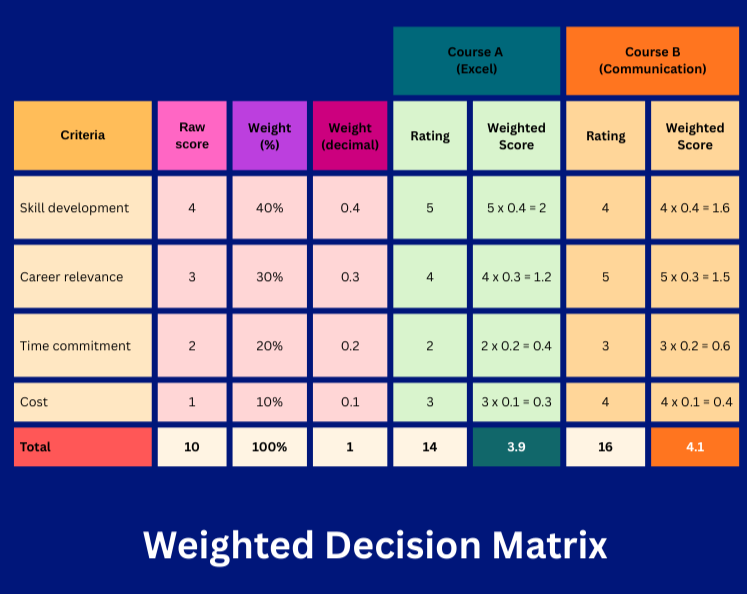 Image created by the author using Canva.To hear an audio version of the information in the image above, click the play button on the audio player below:
Making It Your Own

The joy of a decision matrix is that it’s an adaptable tool for organizing and comparing options — one you can shape to fit your situation by:
Choosing the criteria most relevant to your situation
Adding weight to the factors that carry the greatest influence
Adjusting the scale for more detail (like using 1-10 instead of 1-5)
By tailoring the matrix, you’ll see how each option compares and how your priorities guide the outcome.
Check out this resource for more guidance on how to create your own decision matrix!
Take Action
 Remember, a decision matrix won’t choose for you, but it can help you organize your thoughts when decisions aren’t straightforward. Try it on a decision you’re facing — big or small — and see how it can help guide you toward a clearer, more confident choice.
Your feedback matters to us.
This Byte helped me better understand the topic.