
Coworkers Adam and Mark arrive at work in high spirits and with enthusiasm.While they know each other well, they work in different departments.
Today, they each have a separate one-on-one meeting with their team lead after submitting their weekly reports.
Adam's team lead says: “I noticed you stayed late to finish the client report. That kind of dedication matters. I’ve blocked off an hour this afternoon for us to brainstorm how to automate the data entry so you don’t have to burn out. By the way, the client loved your work! I made sure you got credit for it.”
Result: Adam walks away feeling seen, valued, and ready to solve problems.

Mark's team lead says: “That report was late. I had to resend it myself. Next time, don't take shortcuts. Also, I need you to redo the charts. They don't match my vision. Stay until it's done!"
Result: Mark walks away feeling deflated, confused, and already looking for an exit.

Two leaders, two outcomes: one employee who thrives, and one who merely survives.
Great leaders turn obstacles into opportunities. Bad leaders turn people into obstacles.
Researchers have found that the most successful teams are the ones where everyone feels "psychologically safe."
Psychological safety means that teammates feel comfortable being themselves. They can ask questions, make mistakes, or speak up — sharing ideas, questions, and concerns — without fear of punishment or humiliation.
Psychological safety can mean the difference between a thriving team and one that doesn't grow and bloom.
What Makes a Good Leader?
According to the Center for Creative Leadership, great leaders not only help a business make more money and keep customers coming back. They're key to employees staying at their jobs longer.
They show leadership with:
Credibility: They cultivate trust by delivering on promises and taking ownership of their actions. Moreover, they prioritize the team and don't make everything about their own feelings.
Humility: They gain trust by elevating their teams, advocating for their needs, and crediting them for their work.
Self-awareness: It's essential for leaders to be aware of their behavior, as it sets the tone for their team, especially during high-stress moments.

A good leader is like a consistent gardener who waters, removes weeds, and makes sure every plant gets what it needs.
The result? A healthy, thriving team.

Why Bad Leaders Hurt the Team
We as humans respond to the environment we’re in. And too many times, I see leaders put their team in an environment they can’t succeed in, expecting a different result.
— Jeff Johnson, Hawes Financial Group
In a 2025 study, 40% of employees cited poor leadership as a major reason for workplace stress and burnout, while 37% of younger employees (18-34) reported that they'd be willing to accept a pay cut for better mental health support.
High-profile cases like the Enron scandal illustrate how ego, fraud, and a toxic culture destroy organizations at the highest level.
In an environment with poor leadership, this can lead to lower team participation, lower team morale, and little growth/creativity in idea-sharing.
Think of a bad team leader like a garden without water or sunlight, where the plants droop, leaves turn brown, and eventually nothing grows.

Dismissiveness: The Mistake Many Leaders Make
Psychological safety means feeling safe to speak up — sharing ideas, questions, concerns, or mistakes — without fear of punishment or humiliation.
Dismissive statements like the ones below can directly harm psychological safety:
“Your feelings don’t matter.”
"Calm down."
“Stop being difficult.”
"Just do the job."
"You're lucky to have a job."
“I don’t have time for this.”
When a leader uses this language, they actively teach employees that speaking up is dangerous. Instead of solving the problem, it adds new fuel: frustration, resentment, and mistrust.

A Simple Framework for Heated Moments
Anger isn't always the enemy of good teamwork. Silencing anger is. When teammates get fired up, the best thing a leader can do isn't to shut them down, but to open the door.
Professor Max Bazerman from Harvard Business School says:
If you yell at someone, that person is likely to yell back. The same principle works in reverse: if you listen calmly, the other person will start to calm down, too. You don’t have to demand calm — you just have to model it.
When things get heated on your team, follow this framework:
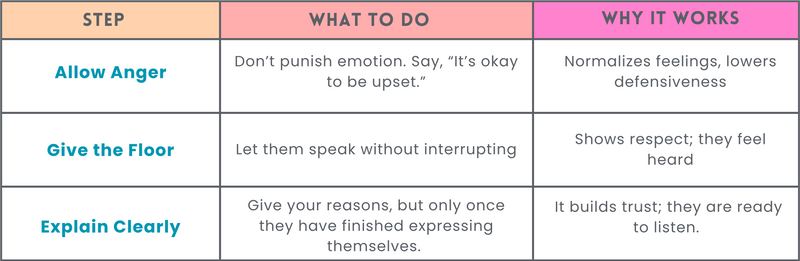 Adapted from "Colorful Clean Rainbow Timetable" by SmartlyDesigned on Canva. To hear an audio description of the chart above, click play on the audio player below:
Who Would Make the Best Team Lead?
Project Background
The product launch is in six weeks, and the project is already behind schedule. The previous team lead was reassigned because they failed to create psychological safety. Specifically:
Public blame: They would ask questions like “Who missed this?” in a harsh way during meetings, treating risks as individual failures.
Punitive escalation: They immediately escalated mistakes to senior leadership and named the people involved, so teammates learned to hide problems until they became crises.
The team's senior product manager met with new candidates for the team lead role, making notes on each person's approach to team leadership:

Alex
Approach: "I’ll make it safe to raise workload, confusion, or capacity concerns early. I’ll set direction but stay open to disagreement, and treat struggles as shared problems, not blame."
Manager's note: “Shared problems” can blur individual ownership and lead to avoiding hard accountability.

Bailey
Approach: “I’ll draw out quieter teammates to ensure their perspective is heard and, prevent anyone from dominating. I'll be transparent about when I’m supporting vs. gathering input, and separate the work from the person in feedback.”
Manager's note: Consensus-seeking may slow decisions in a six-week crunch; no tie-breaking method.

Charlie
Approach: “I’ll make check-ins supportive, not surveillance. I'll set clear expectations. If we slip, understand blockers together rather than blame or escalate in a fear-driven way.”
Manager's note: May avoid necessary escalation; “supportive” check-ins could lack the rigor needed for a slipping schedule.

Dakota
Approach: “I’ll make it safe to say ‘I don’t know’ or ‘I made a mistake,’ invite feedback on my leadership, and treat blockers as shared team issues without judgment.”
Manager's note: "Shared" responsibilities still need individual owners, but feedback & encouragement might bring more initiative-taking.
Quiz
Which candidate is the most psychologically safe choice for an effective team lead?
Take Action
"Leadership is not about being in charge. It is about taking care of those in your charge."
— Simon Sinek, leadership consultant
A great team lead earns trust, rather than demanding it by owning mistakes, delivering on commitments, and prioritizing the team’s success over their own ego.
Now go be the leader your team needs to grow! 🌿
Your feedback matters to us.
This Byte helped me better understand the topic.